

Fire Behaviour and Fuels 2026: Lessons for disaster resilience
At the end of April, I had the opportunity to attend the International Association of Wildland Fire (IAWF) Fire Behaviour and Fuels Conference in Nipaluna Hobart. This was my first time attending this conference, and I really enjoyed the breadth of topics discussed. Bringing together local and international wildfire (bushfire for us Aussies) researchers, fire practitioners, and policymakers, the conference program created space for wide-ranging conversations on the deeply intertwined relationships between the environments in which we live, fire, and people. With so many great options to choose from on the program, I put my human geographer hat on and attended the keynote sessions and streams on Indigenous Knowledge and Collaborative Fire Stewardship, and Human Dimensions.
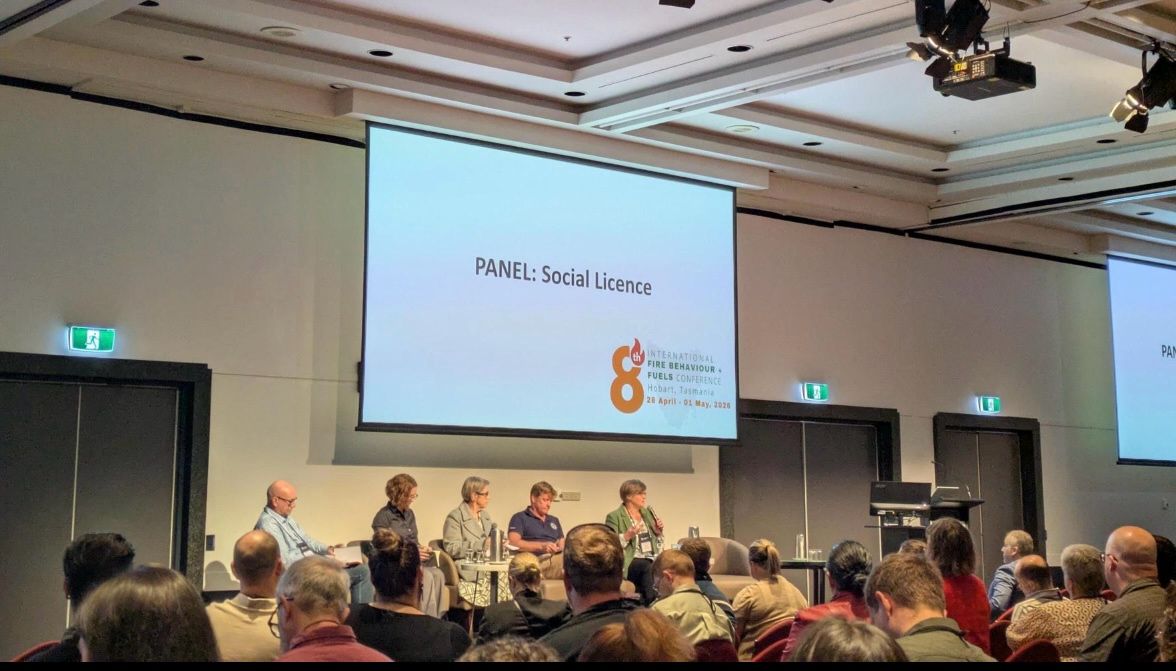
Delegates at Fire Behaviour and Fuels 2026 discuss the growing complexity of wildfire risk and the need for interdisciplinary approaches to fire management. Image: AIDR.
The presentations consistently returned to the growing complexity of fire behaviour and the limitations of focusing only on technical approaches. A strong theme throughout the week was the need to work across disciplines, sectors and knowledge systems, and to better connect wildfire research with systemic considerations like land use planning, policy, building codes, insurance, Indigenous knowledges, and local contexts.
I particularly enjoyed the keynote from Robb Clifton (Australian Antarctic Division) and the subsequent panel on social licence. It was an intriguing choice for a keynote, given Antarctica does not have any trees or shrubs. However, Robb’s discussion of the intersection of international policy, immense risk management and logistical challenges in a harsh environment, the importance of social licence from the Australian public, and managing small interdisciplinary teams, provided insights that could readily be applied to a range of contexts. The next panel further explored how to build and maintain social licence, and the consequences if organisations lose social licence. One interesting provocation considered what could happen when organisational behaviour or culture comes into conflict with individual employee values.
Across the 3 days, I also found myself reflecting on what it means to have respectful, meaningful collaborations for research translation, and how these relationships support AIDR’s work in creating and sharing knowledge that is evidence-informed, grounded in practice, useful, and usable. The sessions on Indigenous Knowledge and Collaborative Fire Stewardship also kept me thinking about how we (AIDR and the wider sector) appropriately and respectfully embed Indigenous knowledges and wisdom in line with principles of Indigenous Data Sovereignty.
On the Friday, I co-hosted a workshop on the Social Dimensions of Compounding and Cascading Disasters alongside Dr Blythe McLennan (AIDR), Professor Lisa Gibbs, and Dr Claire Leppold (University of Melbourne). This session stemmed from a series of roundtables hosted by AIDR and the Australian Red Cross to better understand the impacts of compounding and cascading disasters on disaster recovery. It was a valuable opportunity to hear from practitioners and to see whether the concepts and ideas we have been hearing about are resonating with a wider audience.
Overall, the conference was a great opportunity to step back and reflect on the conversations happening in the wildfire space locally and internationally, and what it means for our work in disaster resilience. I’m looking forward to continuing to sit with these ideas and consider how they can inform AIDR’s work going forward.